The Connection Between Healing and Forgiveness: Beyond Longevity Secrets
Mastery Circle International — Tuesday, August 18
— 45 minutes
TIMING MAP
- 0:00–3:00 — Opening (Einstein, the premise)
- 3:00–10:00 — Personal story (stage 4, the photo, the marriage)
- 10:00–19:00 — The forgiveness–healing connection + the science (Pert, PNI, NK cells)
- 19:00–22:30 — Forgiveness and relationships: where love lives in the body
- 22:30–27:30 — Live exercise
- 27:30–31:30 — Living it out / reclaiming childlike openness
- 31:30–33:30 — Closing
- 33:30-44:30 — Mini-Consults & questions
1. OPENING (0:00–3:00)
Ships don’t sink because of the water around them. They sink because of the water that gets inside them.
That’s what unforgiveness is. A hole you don’t even know you have.
Einstein said either everything is a miracle, or nothing is.
Miracles frame forgiveness around the word “give” — you give to someone you love, not just to relieve your own bitterness — reframing forgiveness as an act of generosity toward the other person rather than self-care.

You already know Marianne Williamson.
“Our Deepest Fear” by Marianne Williamson
Our deepest fear is not that we are inadequate,
Our deepest fear is that we are
Powerful beyond measure
It is our light not our darkness that most frightens us
We ask ourselves who am I to be
Brilliant, gorgeous, talented, fabulous?
Actually, who are you not to be?
You are a child of God
Your playing small does not serve the world.
There’s nothing enlightened about shrinking
So that other people won’t feel insecure around you
We are all meant to shine, as children do.
We were born to make manifest
the glory of God that is within us
It’s not just in some of us it’s in everyone.
And as we let our own light shine,
We unconsciously give other people permission
To do the same
As we are liberated from our own fear,
Our presence automatically
Liberates others

Liberating Others and Yourself – You are co-creating
every moment with those around you!

PERSONAL STORY (3:00–10:00)
There’s a photo of me just before coming to the United States underneith my frock I had a growth on my chest, Before getting on the plane my grandmother “burned” it off. I had to remember all I had to change about my personality for it to not reappear later in life. She was teaching me about energy. I know now it was about every apology I gave, or withheld. She understood generational wounds can calcify instead of healing.
She wanted to make sure I didn’t lock away every piece of my heart just to keep functioning. Stress and fearful situations always come. More than ever you understand, Fight, Freeze, Flee or Fawn. I was, I was so good at fawning. Give me a room full of tension and I will find the exact right thing to say to make everyone comfortable except myself. I could de-escalate a hostage situation and blame myself if that was actually needed to move forward. Some of you just laughed a little too hard at that. I see you.
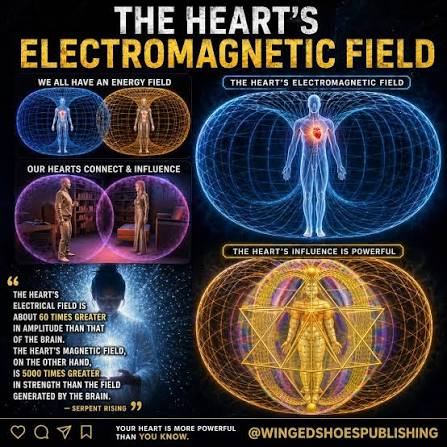
Unforgiveness isn’t just a feeling you get over. It’s a darkness generations carry. It lives in the body — all the way down to the subtle energy, the soul — until the physical form simply can’t carry it anymore.
Your body keeps score. All the way down.
Family, Friends, and Community
This is me now. A marriage that is thriving. A body that healed. A smile that is — actually smiling. Still learning. Still choosing forgiveness on purpose, every single day. It isn’t a one-time decision. It’s a practice.

3. THE FORGIVENESS–HEALING CONNECTION + THE SCIENCE (10:00–19:00)
Here’s what I want you to understand: this isn’t just my story. There is real science behind why this works, and I want to walk you through it — because I think when the mystical and the measurable point in the same direction, that’s when people actually change their lives.
The soul is part of a whole
First, the framework. We tend to think of healing as something strictly personal — mine to fix, mine to carry, mine to fail. But so much of what lives in us was never fully ours to begin with. The unspoken grief in our families. The silence a culture taught us to keep. The trauma a community absorbed and never had space to release.
That whole — your chosen and given family, your community, your culture — is a long chain of people who loved imperfectly, survived what they had to survive, and passed down both their wisdom and their wounds, without always knowing the difference.
Forgiveness is the key that breaks the chain. It doesn’t just serve your own comfort — it ripples backward, to everyone who couldn’t heal, and forward, to everyone who won’t have to carry what you finally choose to put down.
You don’t heal in isolation. You heal as a thread rewoven into the whole.
Now — the biology of that thread

There’s a researcher whose work changed how I understand all of this: Dr. Candace Pert. She was a neuroscientist at the National Institutes of Health — she’s actually the person credited with discovering the opiate receptor in the brain, which was a landmark finding in itself. But what she found next is what matters for us tonight.
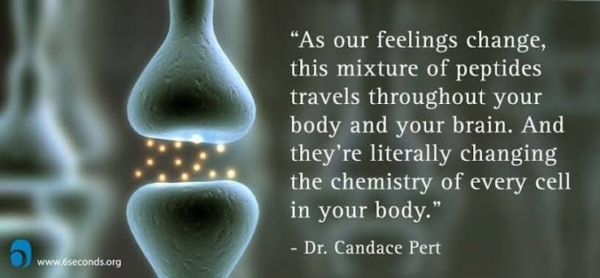
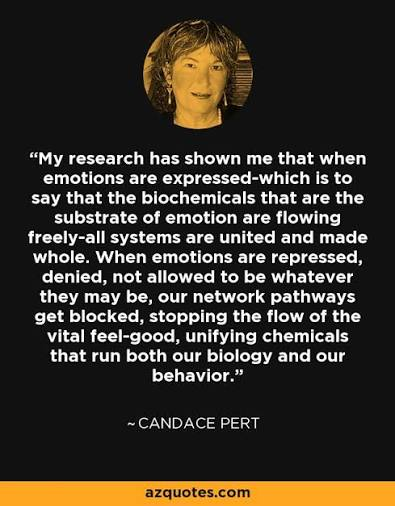
Pert discovered that neuropeptides — the chemical messengers your brain produces when you feel an emotion — don’t just act in the brain. They have receptor sites throughout the immune system. Your immune cells are, quite literally, listening to your emotions. She called this a “psychosomatic network” — a single communication system running between mind and body, with no real separation between the two. This is the foundational research behind the entire field now known as psychoneuroimmunology — the study of how the mind, the nervous system, and the immune system talk to each other.
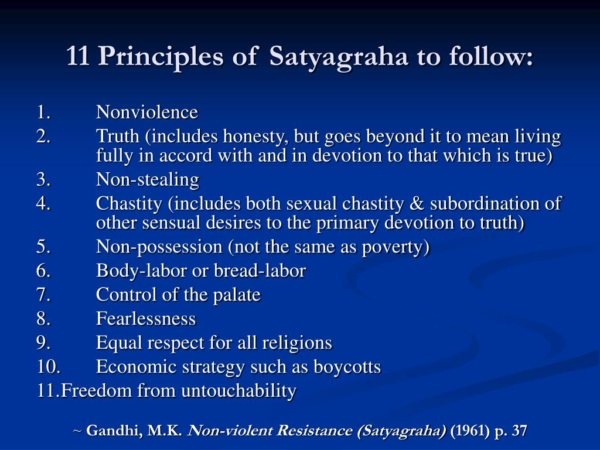
Gandhi principles – taught Imagination
What that means in plain language: emotion is not separate from immunity. Emotion is information your immune system is receiving, in real time.
Now — here’s where I want to be honest with you, because I care more about you trusting me than about a tidy soundbite. The research on specific emotions and immune markers is nuanced. Short bursts of anger, for example, can actually spike certain immune activity temporarily. What the broader body of psychoneuroimmunology research consistently shows is something more specific: it’s chronic, unresolved hostility — anger and resentment that get stored rather than metabolized — that is repeatedly linked to suppressed immune function over time, including reduced activity in natural killer cells, which are one of the immune system’s primary lines of defense against abnormal and cancerous cells. And the inverse also holds up across multiple studies: people who cultivate genuine compassion, connection, and positive emotional states tend to show enhanced immune markers.
So the difference isn’t “never feel anger.” It’s whether that emotion gets processed and released — or whether it gets stored, generation after generation, apology after apology withheld.
That’s the biology underneath what I lived through. Unforgiveness isn’t a metaphor for a wound. Held long enough, it becomes one — measurably, at the level of the cells whose entire job is to protect you.
4. FORGIVENESS AND RELATIONSHIPS: WHERE LOVE LIVES IN THE BODY (19:00–22:30)
Now — everything I just described about emotion and immunity, your body is also doing with the people you love. Forgiveness doesn’t just show up in your own physiology. It shows up in your relationships, in real time, and the research on this is honestly some of my favorite science to teach.
When you first fall for someone, your brain’s reward center floods with dopamine — that’s the intense pull, the can’t-stop-thinking-about-them phase. It’s also why early love makes us a little foolish: activity in the prefrontal cortex, your center for critical judgment, actually drops. “Love is blind” isn’t a saying. It’s neuroscience.
But that early chemistry isn’t built to last, and it isn’t supposed to. Over time, if the bond is healthy, oxytocin and vasopressin take over — the hormones of attachment and trust — and the relationship shifts from a fireworks show into something calmer and steadier. That is the phase where forgiveness becomes the operating system, because passion doesn’t carry a twenty-year marriage. Repair does.
Here’s where it gets even more interesting for us tonight: psychologist John Gottman spent decades studying what makes relationships fail, and he found four specific patterns — he called them the Four Horsemen — criticism, contempt, defensiveness, and stonewalling. Every one of those four is, underneath it, a form of unforgiveness in motion. Contempt is stored resentment with a voice. Stonewalling is the freeze response we talked about earlier, aimed at another person.
And the couples who last — Gottman’s research shows this clearly — aren’t the couples who never fight. They’re the couples who keep a high enough ratio of positive, repairing moments to outweigh the negative ones. Small daily acts of attention. Reaching back toward each other after rupture, over and over. That ratio is forgiveness, practiced in miniature, every single day.
Even our nervous systems synchronize with the people we’re closest to — heart rate, breathing, the subtle rhythms of two bodies attuning to each other. Love isn’t confined to one organ or one moment. It’s a network. And unforgiveness is what interrupts that network from syncing back up.
[transition] So if forgiveness is the technology, relationships are one of the places it does its most visible work.
5. LIVE EXERCISE (22:30–27:30)
You just did, in three minutes, learning how to do. That’s the practice. Every day, on purpose.
6. LIVING IT OUT (27:30–31:30)
So how do we live this, beyond ?
We reclaim the light we knew as children. Before we learned to keep score. Before we learned that love had conditions attached. Children forgive astonishingly fast — not because they don’t feel hurt, but because they haven’t yet learned to store it.
That doesn’t mean naivety. It means choosing, as adults, to metabolize what happens to us instead of archiving it.
Three practical anchors:
- Make it daily, not dramatic. You don’t need one grand forgiveness moment. You need a daily practice — even ninety seconds like we just did — of noticing what you’re still holding and choosing, again, to put it down.
- Forgiveness is not reconciliation. You can forgive someone you never speak to again. Forgiveness is what you do in your own nervous system. Reconciliation is a separate decision, and it isn’t always safe or wise.
- Watch your body, not just your mind. If your jaw, your gut, your chest tightens around a memory — that’s data. That’s your body telling you where the withholding still lives.
This is the bridge between the emotional wounds we carry and the physical patterns that can grow from them. Not because illness is a punishment — it never is — but because the body and the emotional life are one continuous system, exactly as the research shows.
7. CLOSING + INVITATION (31:30–33:30)
Cancer didn’t start my story. Forgiveness is what let me finish writing a new one.
If tonight stirred something in you — a name, a moment, a place in your body where you’re still holding something — I don’t want that to just evaporate when we log off.
I hold space for people who want to go deeper into this individually, through medical intuitive readings — where we look together at where in your body and your history these patterns are living, and what specifically is ready to be released. If that calls to you, I’d love to talk with you.
And I want to open it up now — questions about tonight, about forgiveness, about your own story. What’s coming up for you?
[Open floor / Q&A]
8. Open Floor / Mini Consults Q & A (33:30–44:30)
NOTES
- Cite the science: “Dr. Candace Pert, the neuroscientist who discovered the opiate receptor and went on to found the field of psychoneuroimmunology” is accurate and citable.
- Hostility does not always reduce NK activity — is reduced by “chronic, unresolved hostility is repeatedly linked to suppressed immune function,” !
- Cite by name: dopamine/prefrontal cortex research (Harvard Medical School), oxytocin/vasopressin attachment research, and John Gottman’s “Four Horsemen” and positivity-ratio research (Gottman Institute)